
Parental Burnout in ND Families — Real Signs & a Real Recovery Plan


In this article
01 What ND Parent Burnout Looks Like | 05 Community Support |
02 The 4 Burnout Stages | |
You forgot to eat lunch again. You snapped at your child over something small and then felt the shame flood in. You lie awake cataloguing everything you haven't done, every appointment you nearly missed, every meltdown you didn't handle "right." You've Googled "is it normal to dread mornings" at 2am. You are not failing. You are burning out — and in neurodivergent families, burnout burns differently, deeper, and far more quietly than anyone talks about.
01 · What ND Parent Burnout Looks Like
Burnout in ND Families: Why It Hits Harder
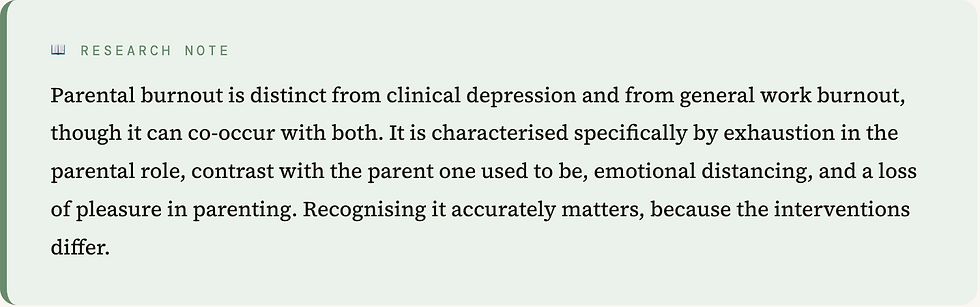
Parental burnout — defined in clinical research as a state of physical, emotional, and cognitive exhaustion resulting from sustained parenting stress — affects roughly one in eight parents broadly. But in families raising neurodivergent children (ADHD, autism, sensory processing differences, dyslexia, anxiety, giftedness, or any combination), the numbers skew dramatically higher.
Studies by Roskam, Mikolajczak, and colleagues have found burnout rates among parents of children with developmental differences are significantly elevated compared to the general parenting population.
The reason is structural: ND parenting doesn't have an "off switch." The school calls. The IEP meeting runs over. The transition from park to car takes forty-five minutes because your child needs time that the world refuses to budget. You become a case manager, an advocate, a therapist-lite, a schedule architect, and a meltdown first-responder — all while managing your own nervous system, which may itself be neurodivergent.

Signs That Are Easy to Miss (or Explain Away)

02 · The 4 Burnout Stages
The Four Stages of Parental Burnout
Burnout rarely arrives as a sudden collapse. It's a slow erosion, and naming the stages helps you catch it earlier — and interrupt it before it becomes crisis.


03 · Micro-Rest Strategies
Micro-Rest: Rest That Fits Into the Life You Actually Have
The self-care industrial complex tells burned-out parents to take weekends away, do yoga retreats, book spa days. For most ND families — particularly solo parents, parents with limited income, or parents whose children cannot be left without intensive support — this advice lands somewhere between useless and insulting.
Micro-rest is different. It works within the constraints of the actual life you're living. Drawing on the work of rest researcher and author Tricia Hersey (Rest Is Resistance), who frames rest not as a reward but as a radical act of reclamation — and on somatic nervous system science — micro-rest targets the physiological roots of burnout, not just its symptoms.
Rest is not a luxury. It is a political act, a form of resistance, and a path back to yourself."— Tricia Hersey, Rest Is Resistance


04 · Delegating Without Guilt
Delegating Without Guilt: The Art of Asking
ND parents often carry a silent belief: If I don't do it, it won't be done right. And if it isn't done right, my child will suffer. This belief is understandable — you've been burned before, by schools that didn't understand, by relatives who dismissed, by systems that failed. Hypervigilance was the rational response to an irrational situation. But it is now costing you more than it is protecting your child.
Reframing Delegation
Delegation is not abandonment. Delegation is a systemic upgrade. When you train, prepare, and hand off a task, you are building your family's capacity — not reducing your standards. You are also modelling for your child that asking for help is strength, not weakness.
What You Can Actually Delegate


Guilt Is Information, Not Instruction
When guilt rises as you delegate, it is telling you something about your beliefs — not about your worth as a parent. Sit with it. Notice it. You do not have to act on it. Guilt that is never tested never changes. Let someone else do the school run. Let the guilt speak. Then let it go.
05 · Community Support
Community: The Missing Pillar of ND Family Wellbeing
We are not designed to raise children in isolation. Humans evolved raising children in communal groups, with distributed caregiving, shared knowledge, and intergenerational support built into the social fabric. Modern life has systematically dismantled this infrastructure, and ND families — who often face additional isolation due to their child's social differences — feel its absence most acutely.
Why ND Parents Become Isolated
The social landscape for ND families is often thin: birthday parties end in meltdowns, park playdates require intensive monitoring, neurotypical parent groups can feel tone-deaf or even subtly hostile to the realities of ND parenting. Over time, the effort of navigating these spaces exceeds the benefit, and parents contract their social world to near-zero.
Finding and Building Your Actual Village


06 · Recovery Plan
Your Real Recovery Plan: Week by Week
Recovery from parental burnout is not a weekend reset. Research by Mikolajczak and colleagues suggests full recovery from clinical parental burnout takes an average of three months with active intervention — and longer without. What follows is a realistic, ND-family-informed plan you can start today.


08 · Closing
A Final Word for the Parent Reading This at 2am
If you have read this far, something in you is reaching for something better. That reaching is not weakness — it is the most resilient thing about you. It is the part that knows you deserve to still be someone, not just someone's parent.
Parental burnout in ND families is real, it is common, and it is recoverable. Not through heroic effort. Not through doing more. Through doing less, more intentionally. Through asking more. Through resting more radically. Through letting your village — however small, however imperfect — hold some of what you have been carrying alone.

You are doing something extraordinarily hard. Please let that be enough for today.

Comments